Live weather alarm-Radar
- 3.6
- Rating
- 100.00K
- Installs
- Free
- Price
 Analysis by App-foxy
Weather apps are easy to underestimate until one gives you a warning at the exact moment you need it. I tested Live weather alarm-Radar with that practical question in mind: can it make weather planning easier without turning a simple forecast into another noisy, complicated tool? My answer is cautiously positive. It is a free tools app from App Musings, built around the idea of using live weather information as an alarm rather than making you repeatedly check a forecast.
That focus gives it a useful place between a standard weather app and a general alarm clock. Instead of treating weather as something you look up only after waking, the app is aimed at helping you plan around changing conditions. The store summary calls it a weather assistant, while its short description presents it as a live weather alarm. Those two descriptions are brief, but together they point to the app’s main appeal: weather information becomes part of a routine instead of a separate task.
I would not describe it as a complete replacement for every weather service. People who need long-range forecasting, detailed maps, severe-weather coverage, or a large collection of widgets may prefer a fuller weather platform. Live weather alarm-Radar makes more sense for someone who wants a focused tool that can connect a weather condition with a moment in the day.
You May Also Like

 Blood Strike: 2.5 Anniversary
Blood Strike’s Loadouts Turn Every Drop Into a Tactical Gamble
A close look at Blood Strike’s custom loadouts: how fast access to signature weapons reshapes its battle royale rhythm, rewards preparation, and narrows the gap between fights.

 Pandora - Music & Podcasts
Pandora’s Music Is Easy to Start, but Harder to Recover
Pandora’s strength is its low-effort path from a seed to a station. Its weak spot is how much confidence it asks you to place in connection, setup, and quiet recovery.

 8 Ball Pool
 Is Built on Rivalries, Rematches, and Routine
A close look at the rivalries, rematches, shared routines, and unanswered safety questions that turn a quick pool match into a persistent mobile community.

 Samsung Music
’s Quiet Strength Is Playing What You Already Own
Its reach comes less from spectacle than from dependable access to a personal library. That simplicity is both the app’s strongest retention engine and its ceiling.

 AccuWeather: Weather Radar
AccuWeather Review: A Quick, Clear Forecast for Everyday Decisions
For everyday plans, the best forecast is the one you can understand quickly. AccuWeather makes rain timing, radar, and local conditions easy to act on, with a few trade-offs.

 Hill Climb Racing
Why Hill Climb Racing Still Turns Crashes Into One More Run
A tiny car, a bumpy hill and one more upgrade: Hill Climb Racing keeps resurfacing because its simple chaos makes every near-miss feel personal.
More From Our News Desk
View All News


What the weather alarm approach feels like in daily use
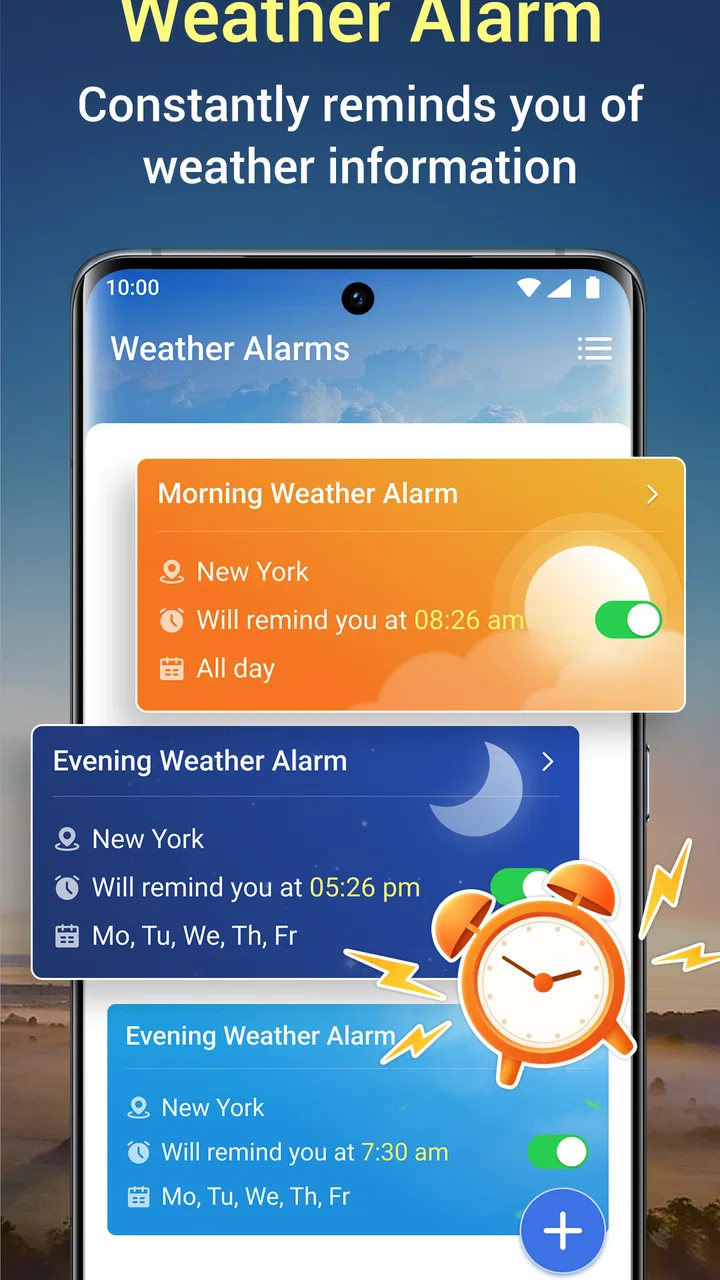
The most convincing use case is a morning routine. Imagine that I have an outdoor appointment, a commute involving a bicycle, or a school run that becomes unpleasant in heavy rain. A normal weather app requires me to remember to open it, interpret the forecast, and decide what to do. An alarm-oriented weather tool changes that sequence: I can make weather part of the decision before I leave bed.
That sounds like a small difference, but it affects how useful the information feels. A forecast viewed casually can be forgotten. A weather alert connected to a planned time has a clearer purpose. I found this approach more practical when the weather itself was the deciding factor, such as choosing between walking and taking transport, carrying waterproof clothing, or moving an outdoor plan indoors.
The trade-off is that the app’s value depends on how thoughtfully I set up my routine. It is not magic automation that removes every decision. I still need to know which weather situation matters to me and when the warning would be useful. If I create too many alerts, the concept can lose its benefit and become another stream of interruptions.
That is my first important tip: use the app for decisions, not curiosity. A weather alarm is most helpful when it answers a question such as “Should I leave earlier?” or “Do I need rain protection?” It is less useful if I configure alerts for every minor change. Keeping the purpose narrow makes the notifications easier to trust.
Who will get the most from it
I see three particularly good audiences. The first is anyone with a weather-sensitive commute. Cyclists, walkers, delivery workers, and people who spend part of the day outdoors can benefit from a reminder that arrives before the relevant activity rather than after the weather has already changed.
The second is someone who regularly plans around outdoor events. A gardener might want a quick prompt before watering or working outside. A parent might use the idea to prepare clothing and transport for a child’s activity. Someone who exercises outside could use a weather-based routine to decide whether to continue outdoors or switch plans.
The third is a person who dislikes crowded weather dashboards. Many weather apps place radar, hourly forecasts, maps, articles, advertising, and unrelated recommendations on the same screen. If I only want a timely weather reminder, that amount of information can slow me down. The focused alarm concept is easier to understand.
On the other hand, I would hesitate to recommend it as the only weather tool for someone who makes safety-critical decisions from forecasts. Hikers, sailors, pilots, and people working in severe conditions usually need specialized information, local warnings, and several ways to verify what is happening. A simple alarm should support judgment, not replace a dependable source of detailed weather guidance.
Trust begins with visible choices
Weather information feels personal because it is tied to where I live, where I travel, and when I plan to be outside. That makes trust more important than a polished screen. When I evaluate an app like this, I look for clear user choices: what I can configure, whether alerts are understandable, whether I can change or remove them, and whether the app’s behavior is predictable.
Live weather alarm-Radar is presented as a free app for everyone, which lowers the barrier to trying it. Its developer is App Musings, and the app has reached over one hundred thousand installs with an average rating of three and a half from around one thousand ratings. Those figures suggest that it has found a real audience, but they do not eliminate the need for personal testing. A weather alarm is only trustworthy for me if it fits my schedule and gives me enough control over when it speaks.
I also pay attention to the difference between a visible control and an assumption. I do not treat the app’s weather focus as proof that it will cover every location equally well, nor do I assume that a notification is always more accurate than a current observation. My practical recommendation is to test an alert during an ordinary week before relying on it for an important outdoor plan.
A useful trust habit is to begin with one location and one meaningful condition. That makes it easier to notice whether the timing feels right, whether the wording is clear, and whether the alarm arrives early enough to help. Starting small also gives me a simple way to decide whether the app deserves a permanent place in my routine.
Permissions, account control, and data-sensitive moments
Weather tools naturally raise questions about location and notifications. I am most comfortable when an app lets me choose how much convenience I want. If I only need weather for a fixed home area, manually selecting a place can be preferable to allowing continuous location access. If I travel often, automatic location may be more convenient, but I still want to understand when it is being used and how to turn it off.
The same principle applies to notifications. An alarm can be the app’s main benefit, but it can also become irritating if every change receives equal attention. I would review the notification settings after installation rather than accepting a busy default. Keep only the alerts that affect a real decision, and silence the rest. This is not just a comfort adjustment; it helps prevent important warnings from blending into routine noise.
There are also moments when weather data deserves extra caution. A forecast may change between the time an alarm is arranged and the time it is delivered. Local conditions can vary across a short distance, especially around hills, coastlines, and dense urban areas. For a normal commute, that uncertainty may be acceptable. For a dangerous storm or a demanding outdoor activity, I would cross-check with an official warning source and current conditions.
That is one of the app’s clearest limitations as a category tool: an alarm is a delivery method, not a guarantee. It can help me remember to check or prepare, but it cannot turn an uncertain forecast into certainty. I appreciate the concept more when I use it as an early prompt rather than as the final authority.
Another overlooked issue is timing. “On time” does not mean the same thing for everyone. A warning five minutes before leaving may be useful for one person and too late for another who needs to pack equipment, change clothes, or arrange transport. I would set the alarm around the preparation time, not merely the event time. That small adjustment makes the app more useful than simply copying the start of an appointment.
Comparing it with ordinary weather apps and alarm clocks
A conventional weather app is usually better for browsing. It can provide a broader view of the day, help compare hours, and make it easier to explore conditions before making a plan. Its weakness is that it expects me to remember to open it. Live weather alarm-Radar reverses that priority by making the reminder the central experience.
A normal alarm clock is better for fixed schedules. It is dependable for waking up, taking a break, or starting work, but it does not connect that time with an outdoor condition. The weather alarm idea is more context-aware, assuming its configuration matches what I actually need. The price of that extra context is more setup and more dependence on weather information being available at the relevant moment.
There is also a difference between a radar-focused weather service and an alarm-focused tool. Radar is valuable when I want to watch rain movement or make a decision based on what is approaching right now. An alarm is valuable when I want to be reminded before a routine. If I am already looking at a storm cell and deciding whether to leave, radar is the more direct tool. If I am asleep, busy, or likely to forget, an alarm has the advantage.
My practical workflow would combine these roles rather than force one app to do everything. I would use the alarm for recurring, low-effort reminders and a detailed weather source when conditions are serious or changing quickly. That division keeps Live weather alarm-Radar from being judged unfairly as a full meteorological dashboard while still recognizing what makes it different.
Small workflows that make the concept more useful
One workflow I found especially sensible is separating preparation from departure. If rain would make me late because I need extra clothing or equipment, the alarm should precede the moment I leave. This turns the notification into an action cue. I can check the sky, adjust my plan, and still have time to respond instead of receiving information when the decision is already made.
A second workflow is using a “backup check” mindset. I would not create several alarms for the same condition. Instead, I would use one weather alarm as the prompt to open a trusted detailed source when the day matters. This reduces notification fatigue while preserving a second look for unusual conditions.
A third is seasonal adjustment. The weather decision that matters in one part of the year may be irrelevant in another. A rain-focused routine can be useful during a wet period but unnecessary when my schedule changes. I would periodically remove old alerts rather than letting them remain forever. This is a simple form of user control that many people overlook.
A fourth is household planning. If several people share a morning routine, one weather reminder can serve as a conversation starter: check the conditions, decide on clothing, and leave together. I would avoid treating it as an automatic instruction, especially when different people have different destinations. The app works best when it supports a decision that remains visible and understandable.
Where the experience may create friction
The focused design can also feel limited. Someone expecting a rich radar screen, detailed hourly breakdowns, or extensive customization may find the alarm concept too narrow. The name includes “Radar,” but I would still judge the app by the controls and information I can actually use rather than assuming that the name makes it equivalent to a specialist radar service.
There is also the ordinary friction of any alert-based app: notifications must be allowed, settings must be configured, and the phone’s background behavior can affect how reliably reminders arrive. I would check the system notification settings and battery restrictions if an alert seems late or missing. That does not automatically mean the app is at fault, but it is part of the real setup experience on a phone.
People who dislike alarms may also find the central idea intrusive. For them, a widget or a quick glance at a standard forecast could be a better fit. Likewise, users who travel constantly may prefer an app designed around maps and changing locations rather than a routine connected to a familiar place. The right choice depends on whether reminders are helpful or annoying in the person’s daily rhythm.
The app is available at no cost and is rated for everyone, which makes experimentation easy, including for families who want a straightforward weather tool. Still, “free” does not mean it costs nothing in attention. Every enabled alert consumes a little mental space. I would keep the configuration deliberately modest and judge the app by whether it reduces checking rather than encouraging more of it.
Version context and my cautious verdict
Live weather alarm-Radar is currently listed as version one point nine point one, with support beginning at Android eight point zero. It was released on January twenty-ninth, two thousand twenty-six, so I would pay attention to how comfortably it fits my particular phone and routine rather than assuming that a recent release guarantees a perfect experience everywhere.
After using it as a focused planning aid, I think its strongest quality is the way it reframes weather from information into timing. That is genuinely useful when the weather affects a repeated decision. I can see myself recommending it to a friend who often forgets to check the forecast before cycling, walking, gardening, or leaving for an outdoor appointment.
I would recommend a cautious setup: start with one location, one meaningful weather trigger, and an alarm placed before preparation begins. Watch how it behaves for ordinary plans, then decide whether more alerts are justified. For important or hazardous conditions, verify the situation through a more detailed and authoritative source.
My final view is that Live weather alarm-Radar is best as a practical reminder layer, not a complete weather command center. It earns its place when a timely prompt can prevent a rushed or uncomfortable decision. It is less convincing for people who want deep forecasting tools, constant radar analysis, or a fully featured weather dashboard. Used within that boundary, this free tools app from App Musings offers a simple idea with real everyday value, provided I remain in control of the alerts and treat forecasts as guidance rather than certainty.
FAQs for Live weather alarm-Radar
01What is Live weather alarm-Radar, and what does it do?
Live weather alarm-Radar is a weather application designed to provide current conditions, forecasts, radar imagery, and alerts for changing weather. After entering or allowing access to a location, users can typically view temperature, precipitation, wind, visibility, and other useful details. Its radar view is especially helpful for checking whether rain or storms are approaching before traveling, commuting, or planning outdoor activities.
02Does Live weather alarm-Radar provide real-time weather alerts?
The app is intended to notify users about relevant weather changes, such as rain, thunderstorms, severe conditions, or other events affecting a selected area. Alert availability can depend on the region, the data provider, notification permissions, and the app’s settings. Before relying on it for safety decisions, open the alert preferences, enable notifications, and confirm that the monitored locations and warning types match your needs.
03Does the app require location access to work properly?
Live weather alarm-Radar can usually be used by searching for a city or entering a location manually, so continuous location access may not always be necessary. However, allowing location permission can make local forecasts and alerts more convenient, particularly when traveling. For better privacy and battery control, consider granting location access only while using the app unless background alerts are an important reason to keep it enabled.
04Is Live weather alarm-Radar free to download and use?
The application may be available as a free download, but some features can depend on advertising, optional purchases, or a premium subscription. Advanced radar layers, extended forecasts, ad removal, or more detailed alerts may not be included in the basic version. Check the app’s store listing and in-app purchase section before downloading, especially if you want access to every weather tool without unexpected costs.
05How accurate are the forecasts and radar readings in Live weather alarm-Radar?
Forecast accuracy can vary according to your location, the weather data sources used, local geography, and how quickly conditions are changing. Radar is generally most useful for observing nearby precipitation and its movement, but it may have delays or limited coverage in some regions. Treat the app as a convenient planning tool rather than a replacement for official emergency warnings or local meteorological services.
Pros
- Real-time radar makes approaching rain and storms easy to spot.
- Weather alerts can help users prepare before conditions change.
- Clear visual maps are useful for checking weather at a glance.
- Supports planning outdoor activities around upcoming weather.
- Location-based forecasts reduce the need for manual searches.
Cons
- Some advanced radar features may require a paid subscription.
- Alerts can vary in accuracy depending on local weather data.
- Frequent notifications may become distracting for some users.
- Radar maps can consume extra mobile data during frequent use.
- Battery usage may increase when location tracking stays enabled.

Live weather alarm-Radar
Gallery